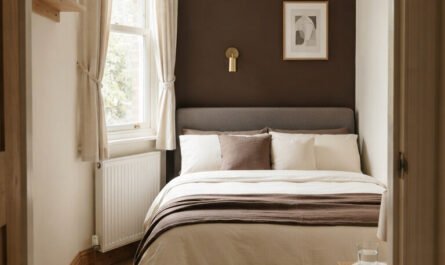
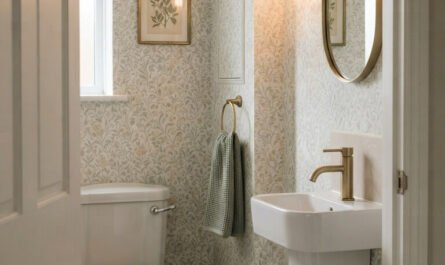
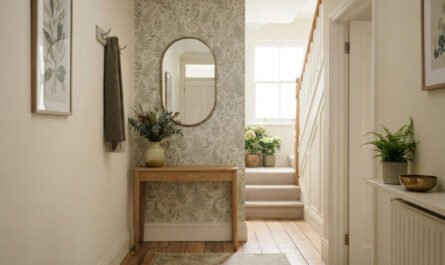
A slim hallway can be one of the trickiest spaces to decorate. There may be barely enough room for coats, shoes and everyday essentials, yet it is also the first part of your home that guests see. The answer is not to squeeze more furniture into the space. Instead, the best slim hallway ideas make every centimetre work harder while keeping the walkway visually and physically clear.
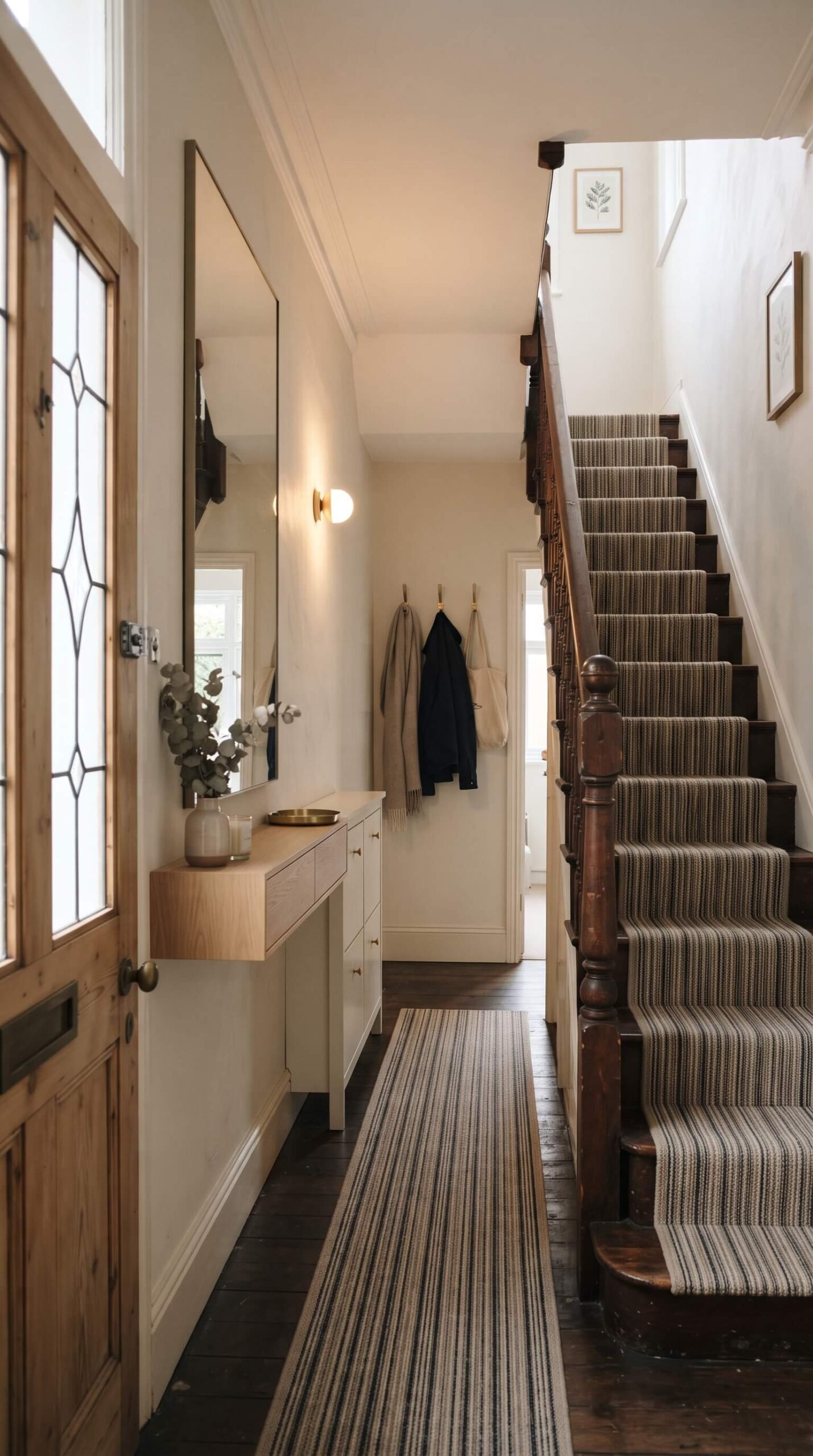
The only woodworking guide built for small spaces and complete beginners. Master 3 real projects using just 5 affordable hand tools even if you live in a studio apartment.


From wall-mounted storage and narrow consoles to clever mirrors, lighter colour schemes and better lighting, small changes can make a surprisingly noticeable difference. This guide focuses specifically on narrow British and Irish hallways, including awkward entrances, terraced-house corridors and compact entrance spaces. You will find practical decorating ideas, storage solutions, budget alternatives and simple ways to make a cramped hallway feel calmer and more spacious.
Slim Hallway Ideas at a Glance
If you only have time for a quick makeover, prioritise these five changes:
| Problem | Best solution | Why it helps |
|---|---|---|
| Floor feels crowded | Wall-mounted furniture | Keeps the floor visually open |
| No shoe storage | Slim shoe cabinet | Uses vertical rather than floor space |
| Hallway feels dark | Layered lighting | Adds brightness without taking space |
| Narrow walls feel oppressive | Large mirror | Reflects light and creates depth |
| Too much visual clutter | Closed storage | Creates a calmer appearance |
The biggest principle is simple: protect the walking route first, then add storage and decoration around it.
1. Choose a Wall-Mounted Console
A conventional console table can easily make a narrow hallway feel even narrower. A wall-mounted version provides a similar surface without bulky legs taking up valuable floor space.
Choose a console that is genuinely shallow rather than simply labelled as “compact”. A slim depth is particularly useful where the front door opens directly towards the hallway.
Style it with only a few objects: perhaps a small lamp, a ceramic bowl for keys and one decorative item.
Why it works: The clear floor underneath creates visual breathing room.
How to recreate it: Look for a floating shelf-style console or shallow wall-mounted cabinet. Fix it securely into suitable wall structure.
Styling tip: Keep accessories towards one side rather than filling the entire surface.
Budget alternative: Use a sturdy floating shelf with concealed brackets.
Best for: Narrow entrance halls where a conventional console would obstruct circulation.
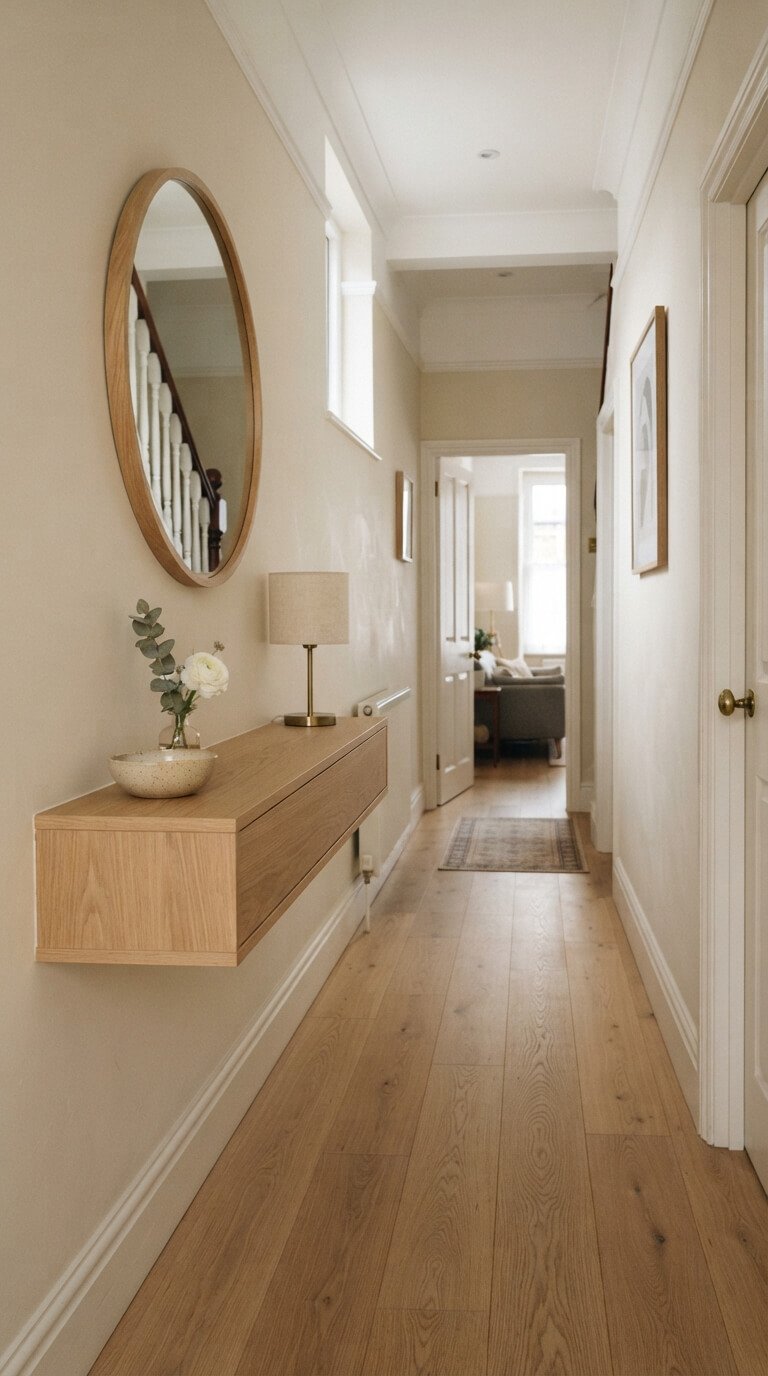
Visual concept: A very narrow British hallway with a 20–25 cm deep light-oak floating console, round mirror above and completely clear floor underneath.
2. Hang a Large Mirror Opposite the Light Source
A mirror is one of the most useful additions to a narrow hallway, but placement matters.
Instead of automatically putting a mirror at the end of the corridor, consider positioning a larger mirror where it can reflect daylight from a nearby window, glazed door or brighter room.
A tall rectangular mirror can emphasise height, while a wide horizontal design can visually stretch a short entrance.
Why it works: Reflection can increase the perception of light and depth.
How to recreate it: Choose a mirror with a slim frame and position it where it reflects something attractive rather than a cluttered coat rack.
Styling tip: Avoid placing a mirror directly opposite a messy storage area.
Budget alternative: Search for an inexpensive full-length mirror and paint its frame to match your hallway.
The only woodworking guide built for small spaces and complete beginners. Master 3 real projects using just 5 affordable hand tools even if you live in a studio apartment.
Best for: Dark, windowless or visually cramped entrances.
Visual concept: A tall frameless mirror reflecting daylight from a glazed front door in a compact cream-painted hallway.
3. Install a Slim Shoe Cabinet
Shoes quickly become the biggest source of hallway clutter.
Open shoe racks are practical but can make a narrow hallway look permanently untidy. A shallow, closed shoe cabinet gives you somewhere to store everyday footwear while keeping the visual line clean.
Look for a cabinet designed specifically for narrow spaces rather than adapting a standard cupboard.
Why it works: Shoes are stored vertically and hidden behind doors.
How to recreate it: Measure the available wall depth carefully before buying. Check that cupboard doors will not interfere with the entrance or walking route.
Styling tip: Keep the cabinet top almost empty. One small tray or vase is enough.
Budget alternative: Use stackable shoe boxes inside a shallow cupboard.
Best for: Busy family entrances.
Visual concept: A slim white shoe cabinet occupying a narrow section beside the front door, with only a small oak tray on top.
4. Use Vertical Coat Storage
When floor space is limited, move storage upwards.
A vertical row of individual hooks can accommodate coats, bags and scarves without requiring a wide coat stand.
Install hooks at different heights if the household includes children, but keep the lowest level clear enough to maintain a comfortable walkway.
Why it works: Wall height becomes useful storage while the floor remains open.
How to recreate it: Choose a simple rail or individual hooks and position them on the most accessible wall.
Styling tip: Keep only the coats currently being worn in the hallway.
Budget alternative: A basic wooden peg rail can be inexpensive and easy to install.
Visual concept: A narrow hallway with a vertical oak peg rail, three neutral coats and woven baskets mounted above a slim bench.
5. Paint the Walls and Woodwork in Similar Tones
Contrasting skirting boards, door frames and walls can visually divide a narrow corridor into separate bands.
Using closely related tones can make the architecture feel more continuous.
This does not mean everything has to be stark white. Warm off-white, pale greige, soft stone and muted sage can all work beautifully.
Why it works: Fewer visual breaks can make the space feel calmer.
How to recreate it: Choose one wall colour and use a closely matched tone for skirting and woodwork.
Styling tip: Test paint samples under both daylight and artificial lighting.
Budget alternative: Paint is one of the more affordable ways to create a noticeable transformation.
Visual concept: A slim Victorian-style hallway painted warm ivory from walls through skirting and door trim, with oak accents.
6. Try a Runner Rug
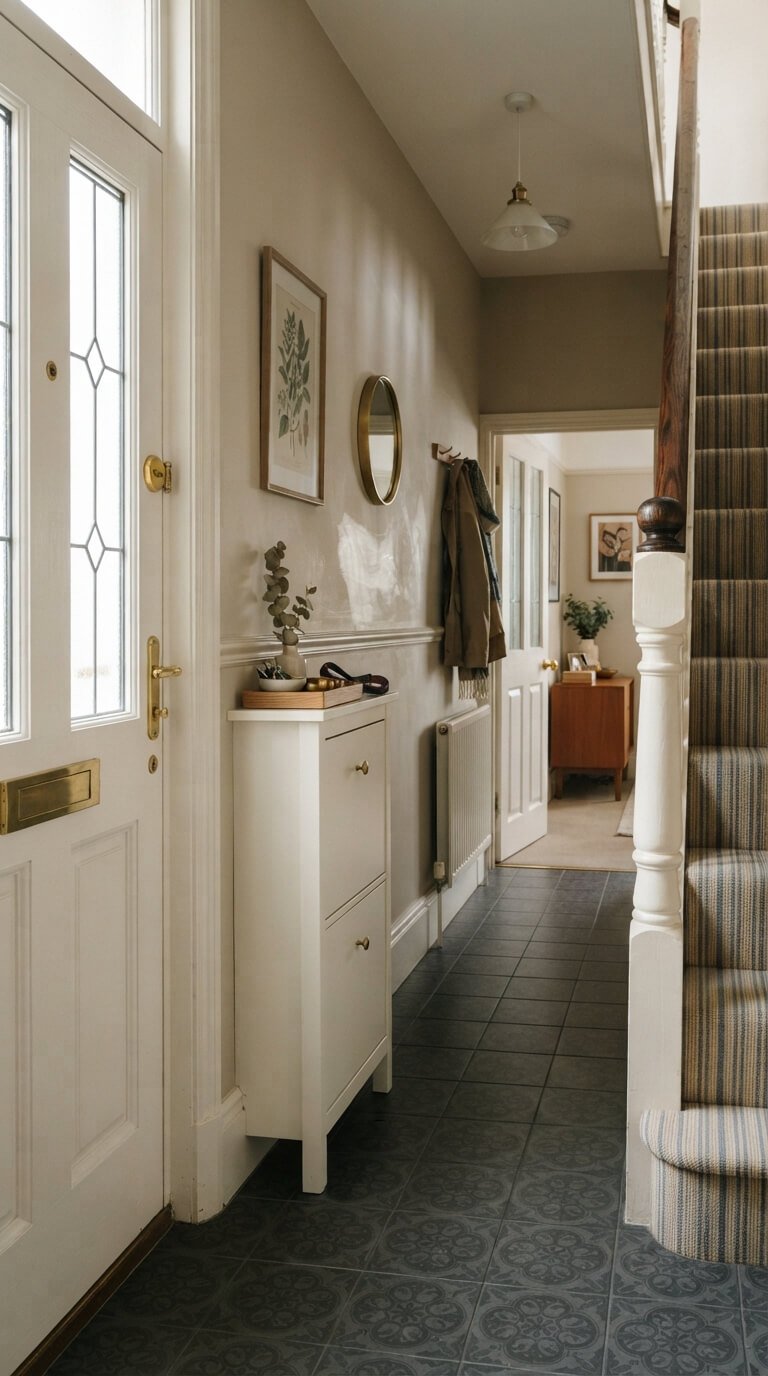
A runner can make a narrow hallway feel finished without requiring additional furniture.
Choose a design that leaves a visible border of flooring along both sides. This helps define the walking route rather than making the corridor appear completely covered.
Flatweave or low-pile designs are practical choices for busy entrances.
Why it works: A runner visually connects the length of the hallway.
How to recreate it: Measure the corridor carefully and choose a rug that leaves comfortable clearance around doors.
Styling tip: A subtle stripe can emphasise the hallway’s length.
Budget alternative: Choose a washable runner or a simple flatweave style.
Visual concept: A long, slim hallway with a muted striped runner, pale walls, dark timber floor and minimal furniture.
7. Use a Narrow Bench With Hidden Storage
If you have slightly more width available, a shallow bench can provide somewhere to sit while putting on shoes.
The key is choosing a genuinely compact model.
A bench with a lift-up seat or drawers can hide shoes, bags and seasonal accessories.
Why it works: One piece solves both seating and storage problems.
How to recreate it: Measure the space between the wall and the normal walking path before buying.
Styling tip: Keep cushions slim rather than adding oversized decorative pillows.
Budget alternative: A small wooden bench with baskets underneath.
Visual concept: A compact oak storage bench tucked beneath a row of hooks in a narrow hallway, with one folded linen cushion.
8. Add a Tall, Slim Plant
Plants can make an entrance feel welcoming, but large floor plants are not always suitable for narrow corridors.
Instead, choose a tall plant with a narrow footprint or use a wall-mounted planter.
Olive trees, snake plants and similarly upright forms can work well when there is sufficient natural light.
Why it works: You get greenery without spreading furniture across the floor.
How to recreate it: Select a plant based on the actual light level rather than appearance alone.
Styling tip: Choose a simple planter in a colour already used elsewhere in the hallway.
Budget alternative: Use a realistic artificial stem if the hallway receives little natural light.
Visual concept: One tall, narrow green plant in a simple ceramic pot positioned at the far end of a bright narrow corridor.
9. Create a Gallery Wall Without Making It Busy
A narrow hallway is an excellent location for family photographs or artwork, but too many frames can make the space feel cluttered.
Instead, choose a restrained arrangement.
A vertical line of three or four frames can emphasise height. Alternatively, use matching frames to create visual consistency.
Why it works: Wall space becomes decorative without reducing floor space.
How to recreate it: Select artwork with a related colour palette and use consistent spacing.
Styling tip: Keep the artwork relatively simple if the hallway already has patterned flooring.
Budget alternative: Print your own photographs and use inexpensive matching frames.
Visual concept: Three vertically aligned black-framed botanical prints on a warm-white hallway wall.
10. Use the Space Above Doors
The area above internal doors is often completely unused.
In a particularly small home, a shallow shelf above a doorway can store baskets containing seasonal items, spare accessories or infrequently used objects.
Why it works: It uses otherwise wasted vertical space.
How to recreate it: Install a properly supported shelf high enough that it does not interfere with door operation.
Styling tip: Use matching baskets so the storage looks intentional.
Budget alternative: Simple timber shelving painted to match the wall.
Visual concept: A slim shelf above a doorway holding three matching woven baskets in a compact British hallway.
11. Choose Wall Lights Instead of Floor Lamps
Floor lamps can obstruct narrow walkways.
Wall-mounted lights keep the floor clear and can also become attractive architectural features.
For a traditional British hallway, aged brass or opal-glass wall lights can complement period details. In a modern home, simple globe or linear fittings may work better.
Why it works: Lighting is added without occupying floor space.
How to recreate it: Position wall lights where they will not be knocked by passing coats or bags, and use a qualified electrician where required.
Styling tip: Use warm-toned bulbs for a welcoming entrance.
Budget alternative: Plug-in wall lights can provide a similar visual effect where suitable and safe.
Visual concept: Two small opal-glass wall sconces illuminating a narrow cream hallway with period mouldings.
12. Use a Slim Picture Ledge
A picture ledge can provide decoration without requiring a deep piece of furniture.
Layer two or three small frames against the wall, perhaps with one small vase or decorative object.
Because the ledge is shallow, it can work where a traditional shelf would protrude too far.
Why it works: It creates display space while keeping the footprint minimal.
How to recreate it: Choose a narrow ledge and secure it properly.
Styling tip: Avoid displaying too many small objects.
Budget alternative: A basic wooden shelf can be painted in a wall-matching colour.
Visual concept: A narrow picture ledge holding three neutral botanical prints and one small ceramic vase.
13. Paint the Ceiling a Soft, Light Colour
Do not forget the fifth wall.
A very dark ceiling can make a narrow corridor feel enclosed, especially if there is limited natural light.
A warm white or very pale neutral can help maintain brightness.
Why it works: The ceiling becomes less visually heavy.
How to recreate it: Coordinate the ceiling with the wall palette rather than automatically choosing brilliant white.
Styling tip: If your walls are warm-toned, use a warm ceiling white rather than a blue-toned white.
Visual concept: A narrow hallway with warm-white ceiling, pale greige walls and subtle recessed lighting.
14. Use Stripes Strategically
Stripes can be surprisingly effective in narrow hallways.
A striped runner can reinforce length, while vertical wall details can emphasise height.
Avoid using strong horizontal stripes across every wall, as they can make the corridor feel visually busier.
Why it works: Directional patterns influence how the proportions of a space are perceived.
How to recreate it: Use one striped element rather than several competing patterns.
Styling tip: Keep the stripes low contrast for a sophisticated look.
Visual concept: A narrow hallway with a cream-and-taupe striped runner running towards the front door.
15. Install a Slim Radiator Cover
Radiators often occupy valuable wall space, but completely hiding them is not always practical.
A carefully designed radiator cover can create a cleaner visual line and potentially provide a shallow surface for decoration.
However, airflow and manufacturer guidance need to be considered before enclosing a radiator.
Why it works: It can make an awkward architectural feature look more intentional.
How to recreate it: Use a properly ventilated design and ensure it does not compromise radiator performance.
Styling tip: Paint the cover to blend with the wall.
Budget alternative: A simple ready-made cover may cost less than a bespoke joinery solution.
Visual concept: A slim, wall-matching radiator cover beneath a small round mirror in a modern narrow entrance.
16. Use Pocket or Sliding Doors Where Appropriate
If a door repeatedly opens into the hallway, it may be consuming valuable circulation space.
Where the building structure and regulations allow, a pocket or sliding door can reduce the amount of floor area needed for door swing.
This is a more involved renovation than painting or adding a mirror, but it can transform an awkward layout.
Why it works: It removes the physical conflict between doors and the walking route.
How to recreate it: Discuss structural requirements with an appropriate professional before altering walls.
Best for: Homeowners undertaking larger renovations.
Visual concept: A compact hallway with a modern timber pocket door fully open, leaving a generous clear walking path.
17. Turn the End Wall Into a Feature
The wall at the end of a narrow hallway naturally attracts attention.
Instead of adding furniture, use it as the visual destination.
A large piece of artwork, an arched mirror or a darker accent colour can create a deliberate focal point.
Why it works: It turns the hallway’s length into part of the design.
How to recreate it: Choose one strong feature rather than filling the end wall with small decorations.
Styling tip: Keep the surrounding walls quieter.
Visual concept: A narrow cream corridor ending in a deep olive-green wall with one oversized framed botanical print.
18. Use a Half-Height Picture Rail
Period homes often have architectural details that can be turned into advantages.
A picture rail or dado-style treatment can divide a narrow hallway visually without requiring furniture.
Paint the lower and upper sections in related shades for a subtle effect.
Why it works: It adds architectural interest without protruding into the walkway.
How to recreate it: Use decorative moulding where appropriate and paint it as part of the overall scheme.
Budget alternative: Lightweight moulding can provide the look at lower cost.
Visual concept: A Victorian hallway with a slim picture rail, warm ivory upper walls and muted sage below.
19. Hide Everyday Clutter Behind One Door
Sometimes the best hallway decoration is simply less stuff.
If possible, designate one cupboard, cabinet or wardrobe for coats, bags, shoes and cleaning items.
Closed storage creates a much calmer visual field than multiple open baskets and hooks.
Why it works: It removes visual noise from the entrance.
How to recreate it: Categorise items before deciding how much storage you actually need.
Styling tip: Keep daily-use items accessible and move seasonal items elsewhere.
Budget alternative: Add internal hooks, shelf dividers and baskets to an existing cupboard.
Visual concept: A narrow hallway with a flush built-in cupboard, closed doors and a single small artwork above.
20. Use a Two-Tone Floor Treatment
If replacing flooring, consider using a durable entrance material near the front door and visually connecting it to the corridor.
In a period property, patterned tiles near the threshold can transition into timber or wood-effect flooring further along the hallway.
Why it works: It defines zones without building physical partitions.
How to recreate it: Choose materials that complement each other in tone rather than competing patterns.
Styling tip: Keep one floor dominant and the second as an accent.
Visual concept: A Victorian-style narrow entrance with patterned encaustic-look tiles near the door transitioning into warm oak flooring.
21. Use Hooks Inside a Cupboard Door
Storage does not always need to be visible.
The inside of a cupboard door can hold hooks for keys, dog leads, reusable shopping bags or scarves.
Why it works: Small everyday objects gain a designated home without taking up wall space.
How to recreate it: Use lightweight adhesive hooks for suitable items or properly mounted hardware for heavier objects.
Styling tip: Group similar items together so the cupboard remains easy to use.
Budget alternative: Basic adhesive hooks are inexpensive for lightweight storage.
Visual concept: Open hallway cupboard showing neatly organised internal hooks holding keys, scarves and reusable bags.
22. Keep the Floor Almost Completely Clear
This is perhaps the most important principle for a genuinely slim hallway.
Before buying another decorative item, look at what is already occupying the floor.
Could the umbrella stand move inside a cupboard? Could shoes go into closed storage? Could a plant move onto a wall shelf?
Creating empty floor area often makes a bigger visual difference than adding another decorative accessory.
Why it works: A clear route makes the hallway feel less obstructed and easier to navigate.
How to recreate it: Photograph your hallway, then identify every object touching the floor. Remove anything that does not need to be there.
Styling tip: Think of the floor as a design feature rather than unused space.
Visual concept: Before-and-after concept showing a cluttered narrow hallway transformed into a clear, bright corridor with wall-mounted storage.
Choosing the Right Solution for Your Hallway
Not every narrow hallway needs the same treatment.
| Your situation | Best starting point | Add next |
|---|---|---|
| Very narrow corridor | Wall-mounted console | Large mirror |
| Dark hallway | Light paint | Wall lights + mirror |
| Family with lots of shoes | Slim closed shoe cabinet | Hooks |
| Renter | Removable hooks | Leaning mirror |
| Period property | Picture rail | Traditional wall lights |
| Tiny entrance | Vertical storage | Minimal décor |
| Long hallway | Runner | End-wall feature |
| Low budget | Paint + decluttering | DIY artwork |
| Renovation project | Built-in storage | Door/layout changes |
Budget-Friendly Slim Hallway Makeover
You do not need to renovate the entire hallway.
For a low-cost transformation, start with decluttering and paint. Then add one mirror and improve the lighting if necessary.
Next, introduce a simple runner and a few coordinated accessories.
A £10–£20 hook rail can solve more practical problems than an expensive decorative table that blocks the walkway.
The best budget strategy is to spend money where it improves function: storage, lighting and durable flooring usually deserve priority over purely decorative objects.
Renter-Friendly Slim Hallway Ideas
Renting does not mean you have to live with a dull entrance.
Use removable adhesive hooks where appropriate, leaning mirrors instead of permanently mounted ones, freestanding narrow shoe storage and washable runners.
You can also introduce personality through artwork, textiles, plants and lamps.
Before using adhesive products, check the manufacturer’s weight limits and your tenancy agreement.
Small Hallway Storage: What Should Stay Out?
A useful rule is to keep only items that are used frequently in the hallway.
Keep nearby:
- Everyday coats
- Current-season shoes
- Keys
- Bags
- Umbrellas
- Dog leads
- School or work essentials
Move elsewhere:
- Out-of-season coats
- Special-occasion shoes
- Empty bags
- Excess scarves
- Rarely used sports equipment
This simple separation can dramatically reduce entrance clutter without buying additional storage.
Colour Ideas for a Narrow Hallway
The best colour depends on natural light, flooring and the adjoining rooms.
Warm neutrals
Cream, ivory, oatmeal and warm greige create a welcoming backdrop.
Soft greens
Sage and muted olive can bring character without the visual intensity of a very dark shade.
Deep feature colours
Navy, forest green or deep olive can work beautifully on a single end wall.
Tonal schemes
Using several related shades is often more cohesive than combining many contrasting colours.
For a narrow hallway, consider the colour of the rooms visible through the doors. The hallway should connect visually with the rest of the house rather than feeling like a completely separate space.
Lighting Ideas for Slim Hallways
A narrow hallway can look smaller when it is poorly lit.
If possible, combine more than one type of lighting.
Ceiling lighting provides general illumination, while wall lights can add warmth and visual interest. Decorative lamps work well on a console if there is enough space.
Mirrors can then help distribute existing daylight.
Avoid relying on one harsh overhead light if the hallway feels cold or flat.
Common Slim Hallway Mistakes to Avoid
Buying furniture before measuring
A piece labelled “slim” may still be too deep for your particular hallway.
Leaving shoes in open piles
Open clutter makes a narrow space feel narrower.
Using too many tiny accessories
Many small objects can create visual noise.
Blocking door swings
Always check how doors open before installing furniture or storage.
Choosing oversized rugs
A runner that is too wide can make the available walking space feel restricted.
Ignoring the ceiling
The ceiling contributes to the overall sense of enclosure.
Using mirrors without considering the reflection
A mirror reflecting clutter simply makes the clutter appear twice.
Before-and-After: A Simple Transformation Plan
Imagine a narrow entrance with beige walls, an overflowing coat rack, shoes on the floor and a small table blocking the walkway.
The transformation does not need to involve a complete renovation.
Before: bulky table, open shoe rack, multiple coats, dim overhead light.
Step one: Remove everything that does not need to live in the hallway.
Step two: Replace the table with a shallow floating console.
Step three: Install a slim closed shoe cabinet.
Step four: Reduce visible coats to everyday essentials.
Step five: Add a large mirror where it can reflect daylight.
Step six: Introduce a narrow runner.
Step seven: Improve the lighting.
The result is not necessarily a physically wider hallway. It simply functions and looks less crowded, which is the real objective.
Which Slim Hallway Idea Is Best for You?
If your hallway is extremely narrow: Prioritise wall-mounted storage and keep the floor clear.
If your hallway is dark: Start with warm light paint, better lighting and a strategically placed mirror.
If you have children: Choose closed shoe storage plus accessible hooks.
If you rent: Focus on removable hooks, a leaning mirror, artwork and a runner.
If you live in a Victorian or Edwardian house: Work with existing mouldings, picture rails and period flooring rather than covering them.
If your hallway is long rather than extremely narrow: Use a runner, repeated lighting and an end-wall focal point.
If your budget is small: Declutter first, repaint second and add one strong accessory rather than several inexpensive ones.
FAQs About Slim Hallway Ideas
How can I make a very narrow hallway look wider?
Keep the floor as clear as possible, use a light or tonal colour scheme, add a strategically positioned mirror and choose shallow or wall-mounted storage.
What furniture works best in a slim hallway?
Floating consoles, shallow shoe cabinets, narrow benches and wall-mounted storage tend to work better than conventional deep furniture.
Should a narrow hallway be painted white?
Not necessarily. Warm neutrals, pale greens and soft greiges can work beautifully. The best colour depends on the amount of natural light and the colours of adjoining rooms.
Is a runner a good idea for a narrow hallway?
Yes, provided it leaves enough visible flooring at the sides and does not interfere with doors. A subtle stripe can also emphasise the hallway’s length.
Where should I put a mirror in a narrow hallway?
Place it where it can reflect natural light or an attractive view. Avoid positioning it opposite a cluttered coat area.
How do I add storage without making my hallway smaller?
Use the walls and vertical space. Wall-mounted hooks, floating shelves, shallow cupboards and tall storage make better use of limited floor area.
What is the best slim hallway idea on a budget?
Decluttering and repainting are good starting points. After that, add a simple mirror, hooks and a narrow runner rather than purchasing bulky furniture.
How can I make a rental hallway look better?
Use removable hooks where suitable, leaning mirrors, freestanding storage, rugs and artwork. These changes can add personality without permanent alterations.
Can dark colours work in a narrow hallway?
Yes. A dark shade can be effective on an end wall or within a well-lit entrance. Using a dark colour throughout a very poorly lit corridor may require more careful lighting.
Final Thoughts
The most successful slim hallway ideas are not about squeezing more decoration into a small space. They are about making deliberate decisions about what deserves valuable floor and wall space.
Start by clearing the walking route. Then solve the practical problems: shoes, coats, keys and bags. Once storage is under control, introduce a mirror, suitable lighting, a runner and a small amount of personality.
If you only make three changes, choose one piece of shallow or wall-mounted storage, one well-positioned mirror and better lighting. These changes can give a narrow entrance a noticeably calmer and more functional feel without requiring a major renovation.
A slim hallway may never become physically wide, but with the right layout, colour, storage and lighting, it can feel considerably more open, welcoming and intentional.
Internal-Link Opportunities
- Small Entryway Ideas — link from the section discussing compact entrance layouts.
- Small Hallway Storage Ideas — link from the shoe and coat-storage sections.
- Entryway Mirror Ideas — link from the mirror section.
- Small Living Room Ideas — useful for readers decorating other compact rooms.
- Hallway Colour Ideas — link from the colour section.
- Small Space Decorating Ideas — link from the opening and conclusion.
- Small Utility Room Ideas — relevant for readers solving storage problems throughout a compact home.
- Clever Storage Ideas for Small Homes — link from the vertical-storage and decluttering sections.
Natural Affiliate-Product Opportunities
- Slim wall-mounted console — directly solves the lack of floor space.
- Narrow closed shoe cabinet — useful for controlling entrance clutter.
- Large slim-framed hallway mirror — supports the light and depth solution.
- Wall-mounted coat hooks or peg rail — practical vertical storage.
- Washable hallway runner — protects the floor while adding visual structure.
- Compact wall lights — useful where floor lamps are impractical.
These products should be incorporated naturally around the relevant solutions rather than turning the article into a product catalogue.