Packing a school snack is easy when you only have to do it once. Doing it five days a week is different.
You need something your child will eat, something you can prepare without turning breakfast into a production, something that survives the trip to school, and—depending on the food and school—something that meets allergy and storage requirements.
That changes the question from “What is a healthy snack?” to a much more useful one:
What snack works for this child, on this school day, under these conditions?
A simple way to thin This isn’t a medical scoring system. It’s a practical filter. A yogurt-and-berry snack may be nutritious but unsuitable if there is no way to keep the yogurt cold. A homemade muffin may be convenient but less substantial on its own. An apple your child reliably eats may be more useful than a beautifully balanced snack that comes home untouched.
The ideas below are organized around those real-world decisions—not just a longer list of foods.
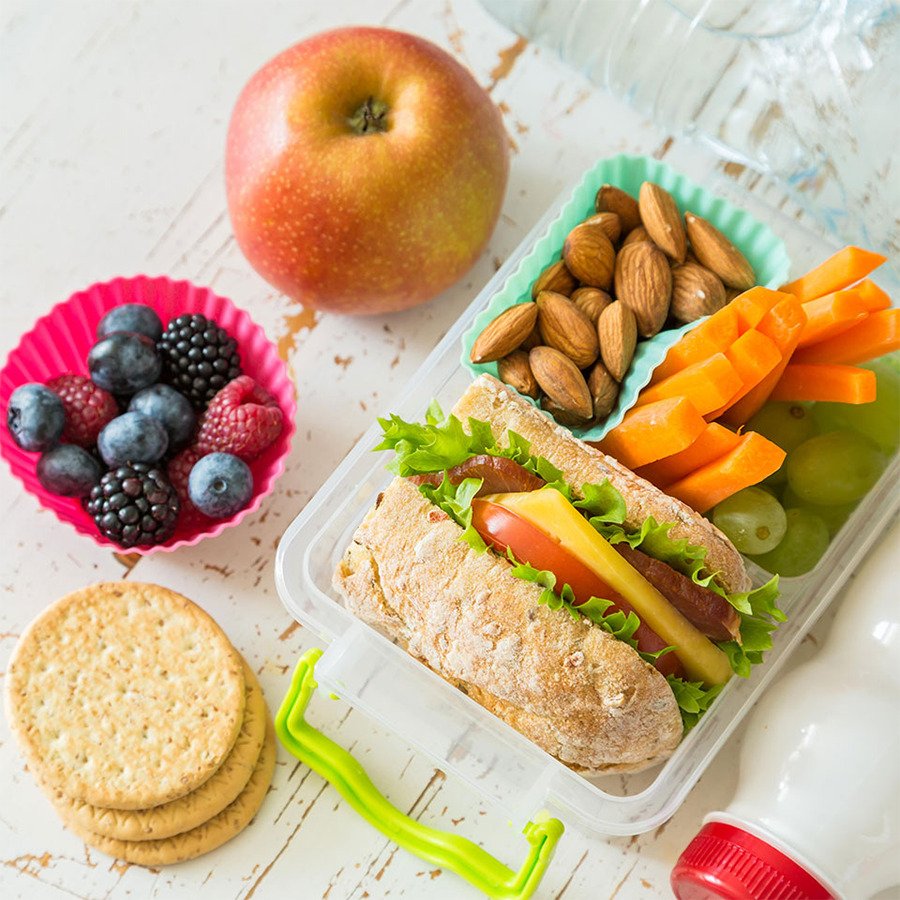
50 Snacks for School to Put on Rotation
Start with foods your child already accepts. Variety can come from changing the combinations rather than introducing a completely unfamiliar snack every morning.
Quick, No-Prep School Snacks
- Apple + cheese
- Banana + yogurt
- Pear + whole-grain crackers
- Berries + yogurt
- Orange segments + cheese
- Whole-grain cereal + fruit
- Grapes + cheese, prepared appropriately for the child’s age
- Cucumber + hummus
- Carrot + hummus, prepared appropriately for the child’s age
- Apple + whole-grain crackers
More Substantial Combinations
- Apple + cheddar + whole-grain crackers
- Banana + yogurt + oats
- Berries + yogurt + whole-grain cereal
- Pear + cheese + crackers
- Cucumber + hummus + whole-grain pita
- Carrot + hummus + pita
- Bell pepper + hummus + crackers
- Fruit + cottage cheese
- Edamame + fruit, where appropriate and permitted
- Whole-grain toast + avocado + fruit
Homemade School Snacks
- Mini banana muffins + fruit
- Oat bites + berries
- Mini pancakes + fruit
- Homemade oat bars + apple
- Zucchini muffins + pear
- Mini whole-grain sandwiches
- Baked oatmeal squares + fruit
- Homemade oat-and-fruit bites + yogurt
- Mini egg muffins, if permitted and kept appropriately cold
- Banana-oat pancakes + berries
Sweet-and-Savory Combinations
- Apple + cheese
- Pear + cheese
- Strawberries + cheese
- Mango + yogurt
- Pineapple + cheese
- Apple + permitted seed butter
- Whole-grain crackers + cheese
- Cucumber + hummus
- Mini pita + hummus
- Fruit + yogurt
Convenient Pantry Options
- Whole-grain crackers + an appropriate shelf-stable companion
- Dry whole-grain cereal + fruit
- Dried fruit + an appropriate accompanying food
- Whole-grain snack bar + fruit
- Plain popcorn, when age-appropriate and permitted
- Whole-grain pretzels + fruit
- Oat-based snack + fruit
- Seed-based snack, where permitted
- Shelf-stable whole-grain snack + fruit
- A familiar packaged snack + fresh produce
The important distinction is that these are starting points, not a ranking from healthiest to least healthy. The right choice depends on the child and the circumstances.
How to Build a Better School Snack
You don’t need 50 recipes. You need a handful of foods that can be recombined.
The USDA’s guidance for healthy eating in children emphasizes variety across fruits, vegetables, grains, protein foods, and dairy or fortified soy alternatives, while limiting added sugars, saturated fat, and sodium.
For an individual snack, a practical interpretation is to begin with produce, then add a complementary food such as dairy, a protein food, or an appropriate alternative. A grain or other carbohydrate can be added when it suits the child’s appetite and the gap until the next meal.
The simple snack formula
Produce + complementary food + optional grain/starchy food
For example:
| Start with | Add | Optional addition |
|---|---|---|
| Apple | Cheese | Whole-grain crackers |
| Banana | Yogurt | Oats |
| Berries | Yogurt | Whole-grain cereal |
| Cucumber | Hummus | Whole-grain pita |
| Pear | Cheese | Crackers |
This is a planning tool, not a rule that every snack must contain three components.
Children’s needs and appetites vary. The American Academy of Pediatrics notes that snacks can be an opportunity to increase fruit and vegetable intake and suggests pairing produce with foods such as dairy or dairy substitutes, lean proteins, or whole-grain foods.
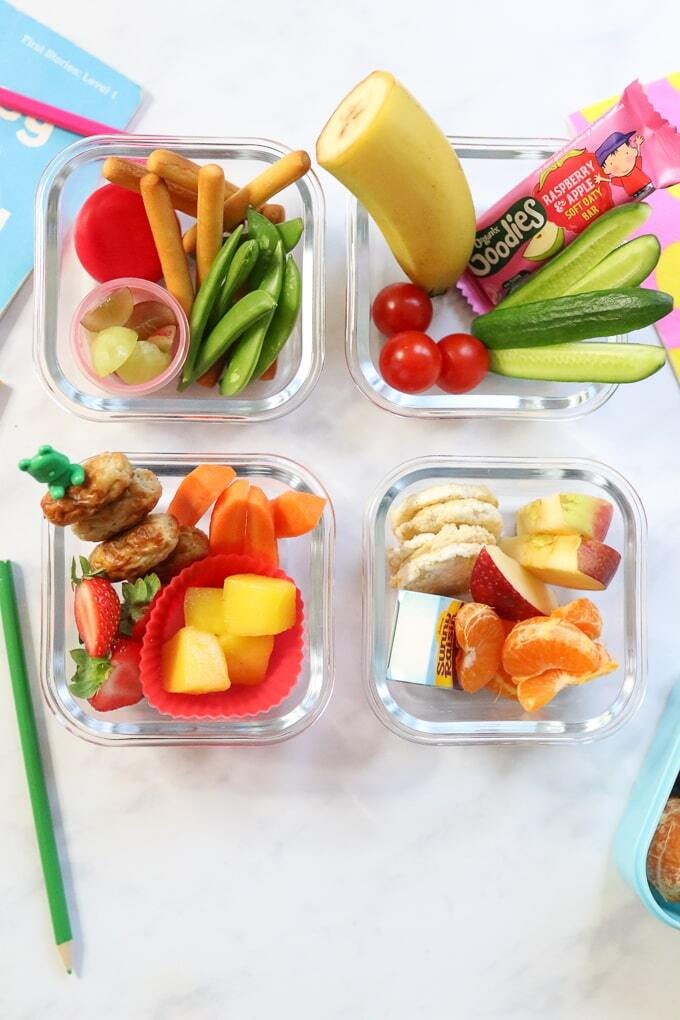
Why combinations often work better than isolated foods
A piece of fruit may be exactly right for a child who had a substantial meal recently. Another child may be hungry again quickly.
Pairing foods gives you more flexibility.
Apple alone: simple and portable.
Apple + cheese: more substantial.
Apple + cheese + crackers: useful when the child needs something more filling before the next meal.
There is no need to make every snack increasingly elaborate. The point is to match the snack to the situation.
The Four-Question School Snack Test
Before putting something in the lunchbox, ask:
1. Will my child eat it?
A nutritious food has little practical value if it consistently returns home untouched.
2. Does it fit the school?
Check rules about nuts, allergens, shared foods, homemade items, and other restrictions. A policy that applies to one classroom may not apply everywhere.
3. Does it need temperature control?
Yogurt, eggs, cheese, meat, and other perishable foods require appropriate cold storage. USDA guidance recommends using an insulated lunch bag and cold sources for perishable foods rather than relying on a paper bag.
4. Can my child manage it?
A container that is difficult to open, a food that requires an awkward utensil, or a snack that makes a mess can fail for logistical reasons rather than nutritional ones.
That last question is easy to overlook.
Best Snacks for School When You Have Five Minutes
On rushed mornings, don’t choose a recipe. Choose an assembly.
Five fast combinations
Apple + cheese
Almost no preparation beyond washing and cutting as appropriate.
Banana + yogurt
Simple, but the yogurt needs appropriate cold storage.
Pear + crackers
Useful when you need something that can be assembled quickly.
Berries + yogurt
Easy when berries are already washed and ready.
Cucumber + hummus
A practical savory alternative to another sweet snack.
Keep two or three “emergency” combinations in regular rotation. Their purpose isn’t culinary excitement. It’s preventing a rushed morning from turning into a skipped snack or an unsuitable substitute.
Healthy School Snacks for Picky Eaters
Picky eating changes the objective.
Instead of asking, “How can I make this snack healthier?”, start with:
“What will my child reliably eat, and what small change can I introduce alongside it?”
For example:
- Favorite crackers + a new cheese
- Familiar apple + a different yogurt
- Preferred bread + a new filling
- Familiar berries + a less-familiar whole-grain food
This approach doesn’t guarantee that a child will accept the new food. It simply avoids making the entire snack depend on something unfamiliar.
The USDA also recommends involving children in choosing and preparing foods in age-appropriate ways.
For a younger child, that might mean choosing between two fruits. An older child might assemble the snack themselves.
Nut-Free School Snacks: Read the Policy First
There is no universal definition of a “school-safe snack.”
One school may prohibit peanuts. Another may have broader restrictions. Some classrooms may have additional procedures for children with diagnosed allergies.
Examples of potentially useful options, if they comply with the school’s policy, include:
- Apple + cheese
- Banana + yogurt
- Pear + crackers
- Cucumber + hummus
- Berries + yogurt
- Fruit + an appropriate seed-based food
For U.S. packaged foods, the FDA recognizes nine major food allergens: milk, eggs, fish, crustacean shellfish, tree nuts, peanuts, wheat, soybeans, and sesame.
If a child has a diagnosed allergy, don’t rely on a website’s “allergy-friendly” label. Read the current product label and follow the child’s medical and school guidance. FDA guidance also points out that ingredient information can change, so previously purchased products should not simply be assumed to have the same formulation.
“Contains” and “may contain” aren’t interchangeable. A “Contains” statement identifies major allergens present as ingredients; advisory statements such as “may contain” are voluntary.
This section uses U.S. labeling rules as its reference point. Other countries may have different allergen-labeling systems and school policies.
School Snacks That Don’t Need Refrigeration
This is one area where a little precision prevents a lot of trouble.
USDA identifies examples of foods that can be suitable without refrigeration, including whole fruits and vegetables, breads, crackers, chips, jelly, mustard, pickles, and some hard cheeses.
But don’t interpret that as “anything in a lunchbox is safe all day.”
Perishable foods need to remain cold. USDA recommends an insulated lunch bag with appropriate cold sources for perishable food; its current lunch-packing guidance recommends at least two cold sources for a cold lunch.
Easier choices for a no-fridge day
- Whole fruit
- Whole vegetables that are appropriate for the child
- Bread or pita
- Crackers
- Some packaged shelf-stable foods
- Other foods whose labels specify room-temperature storage
If you’re unsure whether a particular product is shelf-stable, check its storage instructions rather than guessing.
Make-Ahead Snacks for School
The best make-ahead foods are the ones that save work without creating complicated storage problems.
Good candidates include:
- Mini muffins
- Pancakes
- Oat bites
- Baked oatmeal squares
- Washed and prepared produce
- Portionable dry snacks
- Homemade bars, depending on ingredients and storage requirements
A simple Sunday setup
Choose:
3 produce options
For example:
- Apples
- Bananas
- Berries
2 complementary foods
- Cheese
- Yogurt
2 grain options
- Whole-grain crackers
- Oats or a homemade baked option
You can then create several combinations without buying seven different products.
The calculation is simple:
5 school days × 1 snack = 5 snack occasions
You don’t need five recipes. You need enough components to cover five occasions while allowing some repetition.
That is the difference between meal planning and recipe collecting.
School Snacks by Age
The same food can be appropriate for an older child and unsuitable for a much younger one because preparation and choking risk change with development.
Preschool and kindergarten
Pay particular attention to:
- Texture
- Size and shape
- The child’s ability to chew
- Whether they can open the container
- Whether they can eat independently
- Current choking-prevention guidance
The CDC’s current choking-hazard guidance for infants and toddlers specifically identifies foods including uncut grapes, whole nuts, spoonfuls of nut or seed butter, popcorn, hard candy, and certain large or firm pieces of food as hazards for young children.
That guidance is not a universal list for every school-age child. Use age- and development-appropriate preparation.
Elementary-age children
Older children can usually take more responsibility for:
- Choosing between options
- Opening containers
- Assembling simple snacks
- Communicating preferences
This is a good age to build a small rotation rather than repeatedly packing the same food.
Tweens and teens
Older children may need a more substantial snack depending on:
- Time until the next meal
- Appetite
- Activity
- Sports or extracurriculars
- Individual dietary needs
Convenience also matters. A snack that a teenager can assemble independently is more sustainable than one that requires a parent to prepare it from scratch every morning.
How to Keep School Snacks Safe
Food safety isn’t glamorous, but it is one part of school-snack planning where precision matters.
USDA explains that perishable food should be kept cold during transport and storage. Its guidance recommends keeping cold foods at 40°F (4°C) or below, using an insulated bag and cold sources.
For a cold snack:
- Start with properly chilled food.
- Use an insulated lunch bag.
- Add appropriate cold sources.
- Keep the bag closed as much as practical.
- If the school provides refrigeration, use it according to school procedures.
USDA’s 2024 back-to-school guidance specifically recommends two cold sources for cold lunches and explains how to position them around the perishable foods.
For leftovers, follow food-safety guidance rather than relying on smell or appearance. Some harmful bacteria may not noticeably change a food’s taste, smell, or appearance.
Homemade vs. Packaged School Snacks
Neither deserves to be treated as automatically superior.
| Consideration | Homemade | Packaged |
|---|---|---|
| Ingredient control | Usually higher | Product-dependent |
| Preparation time | Usually higher | Usually lower |
| Portability | Recipe-dependent | Often convenient |
| Portion flexibility | Easy to customize | Often pre-portioned |
| Label information | You control ingredients | Nutrition/allergen information on package |
| Storage | Depends on recipe | Follow package instructions |
| Convenience | Variable | Often high |
A homemade banana muffin can be a sensible choice. So can a packaged whole-grain snack paired with fruit.
The better question is:
What does this particular food contribute, and does it fit today’s practical constraints?
That avoids turning “homemade” into a synonym for healthy or “packaged” into a synonym for unhealthy.
Budget-Friendly Snacks for School
You can build a useful snack rotation from ordinary supermarket staples.
Flexible basics
- Bananas
- Apples
- Carrots
- Cucumbers
- Oats
- Whole-grain crackers
- Yogurt
- Cheese
- Beans or chickpeas
- Homemade muffins or pancakes
The trick is to buy ingredients that work in several combinations.
For example, apples can become:
- Apple + cheese
- Apple + crackers
- Apple alongside a homemade muffin
- Apple with another permitted complementary food
You get variety without buying a completely different packaged snack every day.
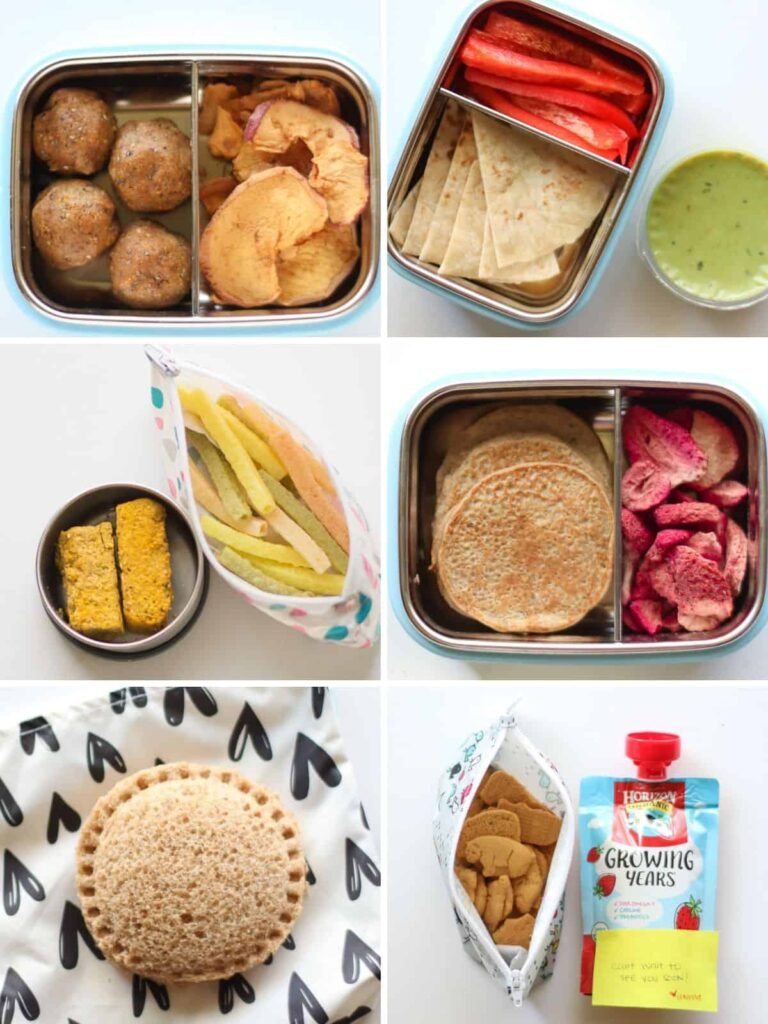
A 5-Day School Snack Plan
Here’s a starting rotation:
| Day | Snack |
|---|---|
| Monday | Apple + cheese + whole-grain crackers |
| Tuesday | Banana + yogurt |
| Wednesday | Cucumber + hummus + whole-grain pita |
| Thursday | Berries + homemade oat muffin |
| Friday | Pear + cheese + crackers |
Adjust it to the actual circumstances.
If dairy isn’t suitable, substitute an appropriate alternative. If Wednesday’s snack can’t be refrigerated, change it. If your child refuses pears, use an apple.
A useful snack plan should be adaptable, not fragile.
Common Mistakes Parents Make With School Snacks
Packing what the child consistently refuses
Nutrition can’t help much if the food never gets eaten.
Making every snack from scratch
Homemade food can be useful, but convenience is a legitimate consideration.
Forgetting refrigeration
Yogurt in an ordinary backpack is not equivalent to yogurt kept appropriately cold.
Treating “nut-free” as a universal safety label
School policies differ, and children can be allergic to foods other than peanuts and tree nuts.
Packing too much
A snack should fit the child’s appetite and schedule rather than becoming a second lunch by default.
Chasing variety for its own sake
A manageable rotation is usually more useful than 20 foods that require 20 separate shopping decisions.
Frequently Asked Questions About Snacks for School
What are the best snacks for school?
The best options are foods the child will eat that also fit the school’s rules, storage requirements, age, and family routine. Fruit paired with cheese or yogurt, vegetables with hummus, and whole-grain foods with a complementary protein or dairy option are useful starting points.
What makes a school snack healthy?
A nutritious snack can include foods such as fruits, vegetables, whole grains, protein foods, dairy, or fortified alternatives. The goal is variety across the child’s overall eating pattern rather than making every individual snack meet a rigid checklist. USDA recommends offering children a variety of food groups while limiting added sugars, saturated fat, and sodium.
What snacks don’t need refrigeration?
Some whole fruits and vegetables, breads, crackers, and other properly shelf-stable foods can be packed without refrigeration. Always follow the food’s storage instructions. Perishable foods require appropriate temperature control.
What are good snacks for picky eaters?
Start with a familiar food and add one less-familiar food alongside it. This allows the child to have something they already accept while giving them an opportunity to encounter a new food without making the entire snack depend on it.
What are good nut-free school snacks?
Depending on the school’s policy, options can include fruit and cheese, yogurt and fruit, cucumber with hummus, or fruit with permitted whole-grain crackers. Always check the school’s current rules rather than assuming that a snack described as “nut-free” online is acceptable.
How do I prepare school snacks ahead of time?
Batch-prep foods that store well, such as muffins, pancakes, oat bites, or appropriately prepared produce. Then combine them with a few ready-to-eat foods during the week.
How many snacks should I pack?
There isn’t one correct number for every child. Consider age, appetite, activity, the school schedule, the time until the next meal, and any school-specific rules.
Are homemade snacks better than packaged snacks?
Not automatically. Homemade foods can provide greater control over ingredients, while packaged foods can be easier to portion, transport, and store. Evaluate the particular food rather than the category alone.
How do I pack yogurt or cheese safely?
Treat them as perishable foods and follow appropriate cold-storage guidance. USDA recommends an insulated lunch bag with cold sources for perishable foods.
A Better School-Snack Routine
The goal isn’t to create 50 different snacks.
Keep a modest selection of foods your child accepts, add a few complementary options, and rotate the combinations. Then run each choice through the same four questions:
Will my child eat it?
Does it fit the school’s policy?
Does it need to stay cold?
Can my child manage it independently?
That turns school snacks from a daily guessing game into a small, repeatable system.
And when the answer changes—because the school bans an ingredient, the child suddenly dislikes yogurt, or there’s no refrigerator available—you don’t need a completely new plan. You simply swap one component for another.
Suggested Internal-Link Opportunities
If this article sits on a food, parenting, recipe, or family-lifestyle site, it should become a hub page rather than a dead-end article.
High-priority links
From this article →
- Healthy Lunch Ideas for Kids
- Easy Lunchbox Ideas
- Healthy Breakfast Ideas for Kids
- Picky Eater Meal Ideas
- Nut-Free Lunch Ideas
- Make-Ahead Breakfast Recipes
- Kid-Friendly Dinner Recipes
- Healthy After-School Snacks
- School Lunch Packing Guide
- Family Meal Planning Guide
Natural anchor-text examples
Instead of:
Click here for more.
Use:
If you’re packing a complete meal rather than a snack, see our healthy lunch ideas for kids.
Or:
For children who resist unfamiliar foods, our picky-eater meal guide goes deeper into gradual food variety.
These links should only be added where those pages actually exist.
Suggested External Source Categories
For a published version, keep the source list compact and authoritative.
Child nutrition
- USDA MyPlate
- American Academy of Pediatrics / HealthyChildren.org
- Reputable pediatric medical institutions
Food safety
- USDA Food Safety and Inspection Service
- FoodSafety.gov
- FDA
Food allergies and labeling
- FDA
- Relevant national food-regulatory authority for non-U.S. audiences
Choking safety
- CDC
- American Academy of Pediatrics or another recognized pediatric authority
For the factual claims in this article, the strongest sources used here include USDA food-safety guidance, USDA MyPlate guidance, FDA allergen-labeling information, CDC choking guidance, and pediatric guidance from HealthyChildren.org.
FAQ Opportunities for Search Expansion
The main article already answers the highest-value questions, but these can become dedicated supporting pages if search demand justifies them:
- What are the best snacks for kindergarten?
- What are healthy snacks for school that don’t need refrigeration?
- What are good nut-free snacks for school?
- What are easy school snacks for picky eaters?
- What are cheap school snacks for kids?
- What are make-ahead snacks for school?
- What are healthy packaged snacks for school?
- What can I pack for a school snack with no fridge?
- What are easy school snacks for teenagers?
- What are healthy after-school snacks?
This creates a natural topic cluster around the cornerstone rather than stuffing every variation into one page.
Related Topic Opportunities
A broader content ecosystem could develop into:
Core cluster
Snacks for School
→ Healthy School Snacks
→ Easy School Snack Ideas
→ School Snacks for Picky Eaters
→ Nut-Free School Snacks
→ No-Refrigeration School Snacks
→ Make-Ahead School Snacks
Adjacent cluster
Kids’ Lunch Ideas
→ Kindergarten Lunch Ideas
→ Healthy Lunchbox Ideas
→ Easy School Lunches
→ Lunchbox Food Safety
→ Budget School Lunches
Supporting cluster
Kids’ Nutrition
→ Healthy Breakfast for Kids
→ Protein-Rich Snacks for Kids
→ Fruit and Vegetable Ideas for Kids
→ Picky Eating
→ Packaged Snacks: How to Read Labels
This gives the original article a realistic path toward becoming a topical hub.
Commercial Opportunities Without Damaging the Article
The strongest commercial opportunities are tools and practical resources, not aggressive product placement.
Possible additions include:
- Printable weekly snack planner
- Downloadable school-snack checklist
- Grocery-list template
- Lunchbox packing checklist
- Recipe collection
- Email newsletter for weekly snack ideas
- Meal-planning template
If the site sells products, relevant contextual links could include:
- Insulated lunch bags
- Reusable food containers
- Ice packs
- Leak-resistant snack containers
- Child-friendly utensils
These should appear only where they solve a problem already discussed. A reader researching school snacks should not suddenly encounter a wall of unrelated product promotions.
Content Refresh Triggers
Review the article when:
- School allergy policies change
- Food-labeling regulations change
- Major allergen guidance changes
- USDA food-safety recommendations are updated
- CDC choking guidance changes
- New authoritative pediatric nutrition guidance is published
- The site’s internal recipe library expands
- Search behavior shifts toward new snack formats
- New school-year trends create meaningful demand
The food-safety and allergen sections deserve the most careful review, because outdated information there can matter far more than an outdated snack suggestion.
Research & Competitive Audit
The current search landscape is dominated by three approaches:
- Medical/pediatric resources explaining why snacks matter and giving a modest selection of examples. Nemours KidsHealth, for example, combines snack guidance with practical examples and routines.
- Nutrition-led list articles offering combinations such as fruit + dairy, vegetables + hummus, and whole grains + protein. HealthyChildren.org and other clinical sources use this approach.
- Large idea lists focused on recipes, convenience, or school-friendly foods. Recent competing pages range from dietitian-written lists to parenting and teacher resources.
The opportunity is not simply to produce 50 more snack ideas. Several existing resources already do that.
The stronger differentiation is the combination of:
ideas + decision framework + storage logic + school-policy considerations + picky-eating strategy + weekly rotation + authoritative safety guidance.
That gives the page a reason to be bookmarked rather than merely scanned for one recipe.
Editorial quality gate
- Search intent: Strong — ideas are provided immediately, followed by decision support.
- Keyword intelligence: Natural — primary and secondary terms are covered without density-driven repetition.
- Topical depth: Strong — nutrition, logistics, allergies, refrigeration, age, picky eating, preparation, and budgeting are connected.
- Originality: Strong — PACK and the four-question test provide practical synthesis rather than fabricated “research.”
- Factual reliability: Stronger in safety-sensitive areas because claims are tied to USDA, FDA, CDC, USDA MyPlate, and pediatric guidance.
- E-E-A-T: Built through source quality and transparent limitations rather than invented credentials.
- Reader experience: Designed around actual school-snack decisions rather than keyword sections.
- CTR potential: Strong but non-clickbait title.
- Retention: The article moves from immediate ideas to increasingly useful decisions.
- Conversion potential: Best suited to planners, recipes, email resources, and genuinely relevant lunchbox products.
- Competitive differentiation: The article treats the snack as a system and decision problem, not merely a list of foods.